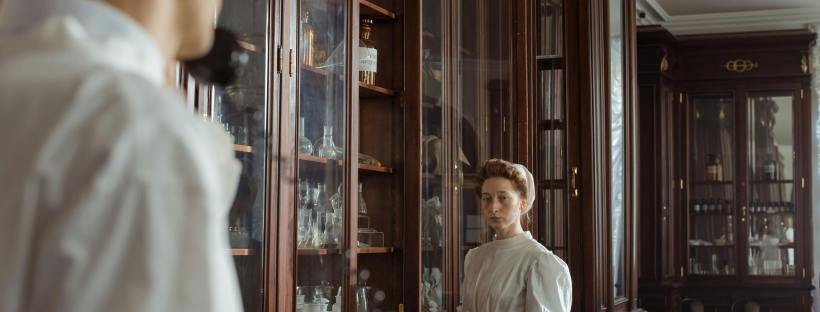
A retroactive translation
The 8th of April, in this year of our discontent
Dear Reader,
Today I have begun to be weaned from my tonic by order of Dr. S—. The reduction is significant — by a third, she has said, “to keep the worst of it manageable.” I had not known the tonic was the only thing keeping the worst of it manageable. Now I shall presumably discover.
The tonic, you understand, was prescribed for the constant motion of my mind — what the modern doctors call attention-disordered, what an older physician might have called nervous fidgeting of the inner self. It worked, after a fashion. The motion slowed. But the rest of me revolted in turn. The blood climbed. The chronic pains intensified. The body protested against its own treatment.
So here I am, by the window, watching the pollen settle on the sill in great quantities. The pollen, you see, is also working against me. It is impossible to know which discomfort to blame at any given hour.
I shall write again tomorrow.
Yours, in slow drifting,
Ms. K—
The 13th of April
Dear Reader,
A most unfortunate episode occurred yesterday. I shall describe it with such delicacy as I can muster.
I was sitting quietly when there came upon me a great roaring in the ears — a high whistle as of distant trains, though no train was near. Then a sudden tremendous heat, as though I had been laid against a stove. Then the curious feeling that the very air was pressing too closely upon my skin. Then I was upon the floor. Then I was being sick into a bowl Mr. T— had thoughtfully positioned for the eventuality.
Once the episode had run its course, I drank a glass of water and was quite well again.
The modern doctors will call this a panic. The older doctors would have called it hysteria. I shall call it what it is, which is that my nervous system, deprived of its accustomed tonic, has elected to broadcast every signal at full volume to see if I am still listening.
Yours, still listening,
Ms. K—
The 20th of April
Dear Reader,
I write to you from the rare state of capacity. The first two weeks of the reduction have brought, alternately: deep fatigue, sudden vigour, hand tremors, a great craving for salt and for the strong sweet drinks of my youth, and a curious quietness in the place where my intrusive thoughts used to live.
I had not realised, before, how much of my mental furniture was intrusive thought. With its volume reduced, the rooms of my mind feel uncannily larger.
Today I cleaned the household for the first time in some weeks. I have written several essays. I have, as the moderns say, named the entire venture of my professional life. The mind, on its own and without the tonic, is producing rather a lot.
I admit I am beginning to wonder whether the tonic was suppressing more than the fidgeting. Whether the chemical balance kept me docile, in part. It is a difficult thought to hold.
Tomorrow the dose reduces again, by half once more. Dr. S— assures me this is the proper schedule. We shall see what the body has to say about it.
Yours, in unsettled capacity,
Ms. K—
The 24th of April
Dear Reader,
I must make introduction here, in the interest of honesty, of two preparations upon which I have grown increasingly reliant.
The first is called Banner — Banner the herb, as the apothecary names it; a vigorous green thing of disreputable origin, said to rouse the limbs and lend purpose to the mind when neither the limbs nor the mind can be persuaded by ordinary means. It is administered, on the rare occasions when one requires the energy of a person who has not been confined to bed for some weeks together, by methods I shall not detail in these pages. Mr. T— is patient with the methods. Dr. S— might not approve.
The second is called Purple Fairy’s Fist — and you must believe me when I tell you that is the actual name, given to it by persons of greater fancy than I. It is an indica, the apothecary says — a word I had to look up; it means the slowing kind. It softens the body’s complaints, dulls the most insistent agonies in the hips and the back, and permits a person who otherwise cannot sit upright to receive a small amount of nourishment without immediate revolt.
Banner for the rising. The Fairy’s Fist for the settling.
I confess to a complicated feeling about both. They are not, by any reasonable definition, medicine — though they are doing the work that medicine, in my case, refuses or fails to do. They are scaffolding. They hold the building up while the building decides whether to stay standing.
I am running, as the moderns say, on scaffolding. It is a sentence I intend to save to repeat in better health.
Yours, in the company of two improbable plants,
Ms. K—
The 30th of April
Dear Reader,
I have done a thing.
I have stopped the tonic entirely. Five days before Dr. S— had scheduled the final cessation. I shall explain at our next interview. I could not bear another day of the yo-yo — the going on and the coming off, the rising pain and the falling pain, the never-knowing what part of me was suffering and which part was easing.
I have told Mr. T—. He held my hand throughout the telling. He has not, in this entire ordeal, asked me to be other than I am.
I vomited copiously while explaining the decision. Fourth episode of the taper. Every dose change has produced one. The body is making its displeasure known by the only means available to it.
I am, at this moment, in a quite specific state of pain. Neither Banner nor the Fairy’s Fist is active in me. I have left them off so as to see what is mine and what is medicated. The answer: it is quite a lot, undismayed and unmedicated, the lot of it.
Tomorrow shall arrive on its own schedule. As shall I.
Yours, decisively unmedicated,
Ms. K—
The 1st of May — Beltane, by the older calendar; the Flower Moon, by the celestial
Dear Reader,
I woke this morning at six in something approaching mania. I leapt from the bed to retrieve the moon-water I had set out under last night’s pull, though my eyes are useless without their spectacles and Mr. T— was already up filling the kettle for the morning tea. I apologised, in my haste and blindness, for not having made the coffee the night before — and then realised, mid-apology, that this was not in fact a thing I do, nor a thing required.
The brain, deprived of its long-accustomed chemistry, is producing strange weather.
It rains, then it shines, then it rains again. I floated away from myself for some considerable hours. I cannot now reliably account for the second half of this morning.
The muscles in every limb feel as though they have been holding tight for weeks together and can no longer remember how to release. There is something almost touching about it. The body holding on so loyally to a treatment that has departed.
Yours, manic-on-wake and grateful for the kettle,
Ms. K—
The 3rd of May
Dear Reader,
I have had what I shall call a first relative reprieve.
I slept. I woke. I did not vomit. My energy was weird and exists — those are my own words for it; I cannot improve upon them. The brain has begun to behave as it once did, before any tonic was ever administered: running in circles, waving its hands above its head, narrating everything to itself. The medication’s purpose departs as the medication does.
I am — what is the word — meeting myself again. It has been some years.
Yours, in tentative re-acquaintance,
Ms. K—
The 6th of May
Dear Reader,
The acute phase has now well and truly passed. In its place: anxiety. Anxiety, and a sensory state so spiked I can hear every bird in the neighbourhood by name.
The nervous system, unbridled, is doing what nervous systems do when they have been long suppressed. It is overcorrecting. It is checking every signal for danger. It is finding danger where there was none.
I had wondered whether the tonic was treating my anxiety as much as my fidgeting. The answer, I now think, is yes — but the conclusion is not what the doctors would draw. The conclusion is that my brain has been protected from itself for some years, and is now learning, in real time, that it can survive without that protection. The bounce is the brain grasping for chemistry it does not produce on its own. It is adjustment, not failure.
I shall let it bounce. I shall not return to the tonic. Not yet. Not while there is data to be gathered from the unmedicated baseline.
Yours, hearing every bird,
Ms. K—
The 7th of May
Dear Reader,
A frame shift. I am writing to you now not from the acute phase but from the long convalescence.
The body is clenched — completely in brace-for-it mode, the muscles unable to release without my actively thinking the thought of release. The brain wants to write and cannot focus. The clenching body and the unfocused brain are the same nervous-system state registered in two locations. I find that diagnosis darkly comforting. It is something to know.
I should perhaps say something about the rest cure itself, since I am presumably still in it. The convalescent home is not quite the convalescent home one reads about — there is no moor, no morning room, no resident physician handing out laudanum at appointed hours. There is a bed. There is Mr. T—. There is tea in the morning before I am awake. There is a kitchen and a garden and a great deal of paper for the writing of essays. The rest cure, it turns out, is what you make in the home you already have, when the body insists on being attended to.
Dr. S— is informed at appropriate intervals. The apothecary is consulted as needed — Banner has been mostly returned to the drawer; the Fairy’s Fist is summoned only when the nerves require their settling. The patient — that is, the lady writing this — is, against all reasonable odds, recovering.
Yours, from the long convalescence,
Ms. K—
The 8th of May
Dear Reader,
The tension is migrating. Yesterday’s full-body brace has loosened in the lower body — the hips, the joints — and gathered in the upper body: the shoulders, the arms. Same nervous-system state, different storage location, as I noted at the time.
I have shipped a newsletter. I have washed a load of dishes. I have laundered a load of clothing. I have ordered the week’s groceries in such a manner as to avoid the family’s habitual fortune-spending on takeaway. It is, by any reasonable accounting, an extraordinary amount of work for a day on which my motivation has been listed as little to none.
The body keeps doing what the body knows to do, even when the mind insists nothing is happening.
Which is, in the end, what the rest cure is. Not the cure itself. Just the staying. Just the writing of these letters. Just the slow learning of what is left when the tonic is gone — and the discovery, against expectation, that what is left is still me.
Yours, from a Tuesday I did not believe I would reach,
Ms. K—

