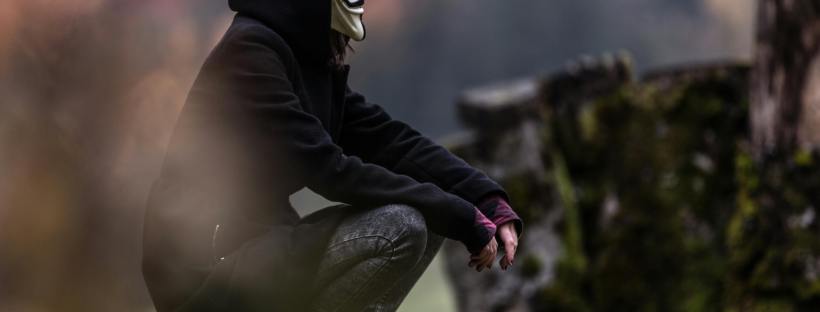
I’ve worn a version of myself like a costume for so long that I don’t always know who’s underneath it. Some days, I’m just a collection of practiced expressions.
A carefully modulated tone.
A perfectly timed laugh.
A soft nod when I want to scream.
A full human suit built to make sure you’re comfortable—no matter what it costs me.
And for a long time, I didn’t even know I was doing it.
I just thought I was difficult to love.
So I got good at becoming whatever you needed me to be.
And no one ever questioned it, because I made it look easy.
That’s masking.
But what is masking?
Masking is what autistic and otherwise neurodivergent people do to survive in a world that wasn’t built with us in mind.
It’s the conscious—or unconscious—effort to suppress or camouflage the parts of ourselves that other people find inconvenient.
Too much. Too intense. Too awkward. Too weird. Too honest. Too quiet. Too loud. Too wrong.
It’s sitting still when your body needs to move.
It’s smiling when you don’t understand the joke.
It’s holding in a stim that would regulate your nervous system because it might make someone else uncomfortable.
It’s learning to make eye contact even though it burns.
It’s studying small talk like it’s a second language, then forgetting your native tongue.
Masking isn’t about being fake.
It’s about being safe.
And when it works—if you can even call it that—no one notices.
That’s kind of the point.
It looks different for everyone. Some of us mask more, some less. Some of us are conscious of it; others don’t realize until we’re deep in burnout and have no idea who we are anymore. The details shift, but the strain feels familiar to so many of us who’ve had to contort ourselves just to get through a conversation, a classroom, a job interview, a life.
What it looks like on the outside
When you’re doing it right, masking looks like you’re just… a person.
Someone who fits.
Someone who “grew out of it.”
Someone who’s “fine now.”
It looks like confidence.
Like composure.
Like emotional regulation and social ease.
It looks like you’ve got it all together.
Which makes it that much harder to explain when you fall apart.
What it feels like on the inside (for me)
It feels like wearing an itchy alien skin suit. Too tight in some places, too loose in others. Like you’re trying to blend in somewhere you were never meant to belong— where no one speaks your language, the rules change mid-sentence, and everyone assumes you’re fine because you’re close enough to whatever they expect.
It feels like holding in every impulse to move or speak or breathe in a way that makes sense to you, because your body learned that its own comfort is suspicious.
It’s physical.
It’s clenching your jaw so you won’t hum.
It’s holding your shoulders stiff to stop yourself from rocking.
It’s smiling with your mouth while your whole body screams.
It’s exhaustion that feels like it’s wired into your bones.
When you have ultra-empathy, it gets worse
If you happen to have ultra-empathy as part of your autism toolkit— and many of us do—masking becomes something else entirely.
You’re not just hiding you.
You’re reading them.
Sensing discomfort before it lands.
Becoming a whole new person to match someone else’s energy, their interests, their emotions.
And when you’re undiagnosed, or late-diagnosed, and you don’t know you’re doing this… you believe that person is you. That the smiling, nodding, accommodating version is the “real” you— and that the parts that want to stim, scream, sob, or leave are just flaws you haven’t fixed yet.
But it’s not a flaw.
It’s a mask.
And keeping it on too long can break you.
Ask me how I know…
So this series—Masking Monday—it’s not here to shame any of that.
I’m not here to tell you to stop masking.
I’m not even sure I can.
But I do want to name it.
To talk about what it takes.
What it costs.
What it hides.
And what happens when we start to peel some of it back.
Because it’s not about lying.
It’s about accommodating.
About people-pleasing.
About trying to be chill so the world doesn’t get hotter.
But that chill has a cost. And over time, it compounds.
This series—Masking Monday—isn’t here to give you “tips” or tell you to stop masking.
It’s here to make the invisible a little more visible.
To name it. To feel it.
To ask, “Is this mine? Or is this who I learned to be?”
When do you need your mask the most—when you’re afraid, or when you’re expected to smile?
 CamiKaos
After my diagnosis and trying to remove the mask and know myself better, I learned that masking is also a survival strategy. The goal now is not so much taking of the mask but finding safe spaces where I can do it, and never forget that there will always be spaces where I need the mask to survive. Those spaces will be fewer and fewer, but sadly, we can’t always avoid them altogether, and in those we still need to survive.
Elena, yes. Exactly.
That’s been such a core part of this for me too—not just unmasking for the sake of it, but getting to choose when and where I do it. And more importantly, when I don’t.
I’ve been working to protect more of my time and energy from being spent on facades, but that doesn’t always look like freedom from the outside. Sometimes it looks like drawing inward. Sometimes it is drawing inward. As an introvert, I know how easy it is for that to be misunderstood… but also how necessary it can be for survival and healing.
I really appreciate how you framed that—acknowledging both the reality and the hope. Thank you for sharing it here.