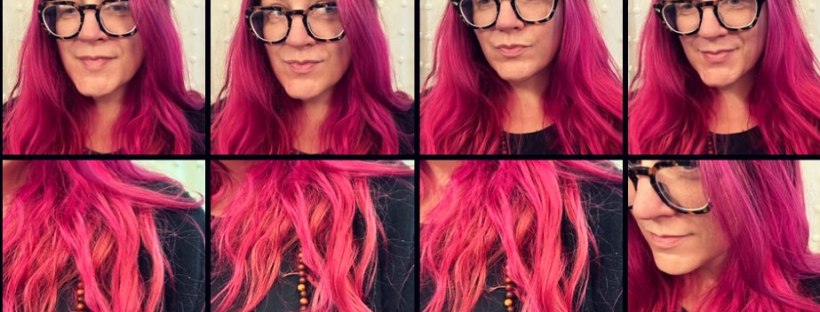
I’m realizing only now, as I near 50, that I haven’t actually hated my hair my whole life. That sounds dramatic, so I should explain a little. I love my hair now. I really do. It’s crazy and wild and it doesn’t care what I want to do with it, it’s just going to be free. It’s kind enough to let me keep it pink, but that and whether or not I cut it off are really the only options I have…
I loved my hair when I was tiny and it was white like cornsilk and just as straight.
I also liked my hair when my mom wrapped it up in tiny foam and plastic rollers for me to sleep in overnight. I delighted in each tiny bouncy curl. They were the exact opposite of my own preternaturally straight hair.
I stopped liking my hair when it changed in color from eerie whiteness to darker blonde. But what even is blonde. I was blonde when my hair was white and somehow also when my hair shifted to nearly brown.
That brown wasn’t even a color. It’s mud. I hated it. I didn’t understand it. I didn’t want blondishbrownishashy hair. How would I ever be able to tell someone what color it is?
And that’s about the time teen Cami got her hands on a box of blue-black hair dye.
This box of dye would accomplish many things. The least of which was turning my hair black that one time. It set in motion a horrifically scarring power struggle for my own identity. One that lasted years beyond the day my mother made me sit in a salon chair for what felt like a full business day while her hairdresser tried to bleach me back to something that seemed natural. She didn’t succeed. What I got was a glowing orangey blonde. I wanted it black. I would have been devastated to be seen in public… except it was still better than the muddled tone I’d grown on my own.
For the vast majority of my life between that first box of hair dye and two years ago, my hair was black. Or blue-black. Or soft black. Or any variation on the color black I could get my hands on. There were breaks. A couple of years with burgundy hair. A brief chemically-lightened return to blonde after I had my daughter. But never natural. Natural has never been my North star. It didn’t matter why I needed my hair to be something else. What mattered was that my hair be the other thing. Not natural, but real.
Years of therapy and a slew of multi-letter diagnoses will make you reflect, though. I feel like my hair has been a victim, or maybe the unwitting beneficiary, of my literal thinking and masking.
And I don’t know if all of you know this, but among the litany of things that change about a woman’s body as she reaches for the sparkly mid-life puberty that is menopause, the very texture of your hair may change.
My hair has always been so.fucking.straight. This shit couldn’t hold a curl unless it was violently manipulated from wet to dry through hours of torture and contortion while I slept. Not six or eight hours. Twelve. In those tiny little curlers that, if you asked me when I was little, I would say my mom was torturing me with, but that I look back on now and realize how I harangued her and begged her to do it. How much I loved it.
It was super cute, sure, but it was also the world’s greatest stim toy for a little girl who had no idea she was stimming all the livelong day.
Back to perimenopause hair. My stick-straight, can’t-hold-a-curl hair is now curly in two spots, heavy wave in the back, and stick-straight holdouts in the front that still refuse to be manipulated by styling.
Oh, and it’s pink now too. Though I think that has more to do with the careful bleaching and dyeing performed twice a year by an angel named Nicolette.
The point is: I need to be able to describe myself physically in undeniable terms so there’s no confusion about who I am in the world. I’ve always needed that. Desperately.
And maybe that’s why “natural” has never mattered to me. Natural was never the goal. People talk about masking like it’s always about being fake, but sometimes the mask is truer than what’s underneath. My black hair, my burgundy hair, my pink hair—none of it was natural, but all of it was real.
Because what I’ve needed all along was to be seen in simple, undeniable terms. To make sure the world knows I exist, even if it doesn’t understand why.
Maybe the world doesn’t deserve my authenticity. But it’s still what I bring: color, texture, style, contradiction. Even if people don’t understand the why, they can’t mistake the fact that I’m Cami.
And now I’ll ask you—what’s the thing you’ve changed about yourself, not to look “natural,” but to claim your place in a world that doesn’t always deserve you?
 CamiKaos